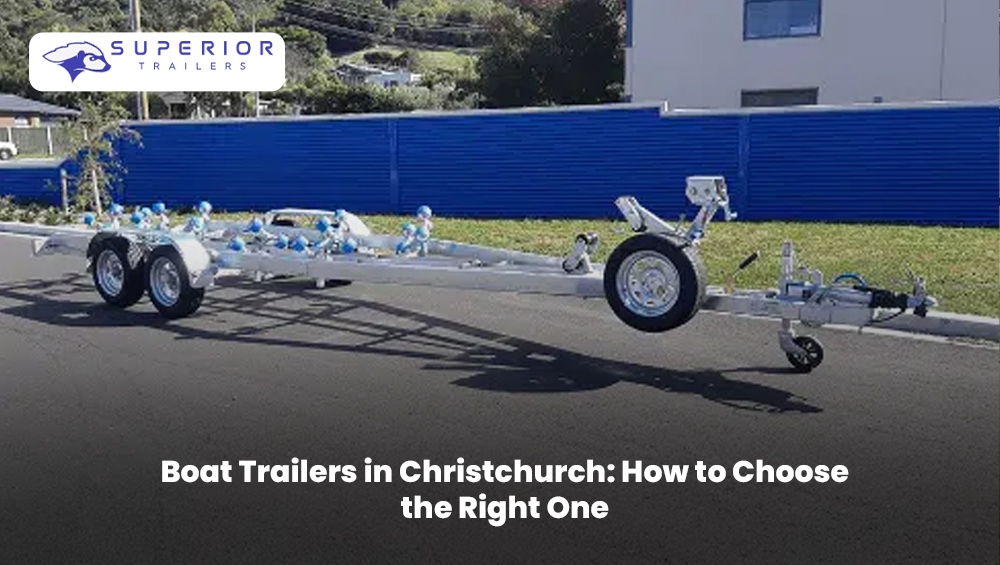
Boat Trailers in Christchurch: How to Choose the Right One
Choosing a boat trailer in Christchurch? Check boat size, weight capacity, durability and towing safety to find the right fit for your boating needs.
Choosing a boat trailer involves more than finding one that fits your boat. The right trailer needs to support the hull correctly, handle the combined load, suit your towing vehicle, and make launching and retrieval manageable.
For boat owners in Christchurch, these details matter when planning trips to coastal launching areas, local waterways, or destinations across the South Island. A trailer that suits your boat and regular use can make transport more convenient and help reduce avoidable wear.
If you are comparing boat trailers in Christchurch, understanding a few key specifications will help you make a more informed decision. Here is what to consider before choosing your next marine trailer.
Why Choosing the Right Boat Trailer Matters
Your boat trailer plays an important role in transporting and storing your vessel. A poorly matched trailer can make loading difficult, affect towing stability, and place unnecessary pressure on the boat’s hull.
The right setup should provide:
- Proper hull support: Rollers or supports should suit the shape of your boat.
- Suitable load capacity: The trailer must accommodate the boat and its loaded weight within its rated limits.
- Stable towing: Correct weight distribution and compatible towing equipment help support safer journeys.
- Convenient launching: The trailer design should suit the ramps and launching conditions you regularly encounter.
- Practical maintenance: Corrosion protection and accessible components can make ongoing care easier.
Thinking about these factors before buying helps you focus on a trailer that works for your actual boating needs, rather than choosing one based on appearance alone.
Types of Boat Trailers to Consider
Boat trailers come in different configurations. The best option depends on your boat’s size, hull shape, weight, and how you intend to use it.
Single-Axle and Tandem-Axle Trailers
Single-axle trailers have one axle and may suit smaller, lighter boats when their rated capacity and design are appropriate.
Tandem-axle trailers use two axles and may be suitable for larger or heavier boats. Their load distribution, handling characteristics, tyre requirements, and maintenance needs differ from those of single-axle designs.
Neither configuration is automatically right for every boat. Check the manufacturer’s specifications and make sure the trailer matches your vessel’s requirements.
Roller-Based Boat Trailers
Roller systems support the hull at selected contact points and can help guide a boat during loading and retrieval.
Adjustable rollers are particularly useful when the trailer needs to accommodate a particular hull shape. However, roller placement and adjustment matter. Incorrect support can put unwanted pressure on the hull.
Bunk or Skid-Based Trailers
Bunk-style supports use longer contact surfaces to support the boat along parts of its hull.
Their suitability depends on the hull design, support placement, and launching conditions. Ask a trailer specialist which support arrangement is appropriate for your boat before deciding.
5 Important Things to Check Before Buying a Boat Trailer
Before comparing individual models, gather the details that determine whether a trailer will suit your vessel.
1. Boat Weight and Trailer Capacity
Start with your boat’s actual weight. Remember that the engine, fuel, batteries, equipment, and other items can add considerable weight.
Check the trailer’s rated gross laden weight (GLW), tare weight, and permitted carrying capacity. GLW refers to the maximum permitted loaded weight, while payload capacity is the weight available for the boat and other carried items.
Do not assume that a trailer advertised for a particular boat length will automatically have enough capacity. Confirm the figures and allow for the boat’s real loaded weight.
2. Boat Length, Width, and Hull Shape
Measurements affect how the boat sits on the trailer and how the overall combination behaves on the road.
Check the hull length and width, keel position, support requirements, and the position of the boat’s centre of gravity. Also consider the overall dimensions of the loaded trailer.
A suitable design should support the hull at the correct points without placing unnecessary strain on the structure.
3. Towing Vehicle Compatibility
Your vehicle must be rated to tow the loaded trailer safely. Check its maximum braked or unbraked towing capacity, towball download limit, and other relevant manufacturer restrictions.
The trailer’s coupling, braking system, and electrical connections must also be compatible with the vehicle.
If you are upgrading to a larger boat, reassess your towing setup rather than assuming your existing vehicle will be suitable.
4. Brakes, Tyres, and Safety Equipment
The trailer’s braking system needs to suit its design, weight, and applicable requirements. Inspect the tyres, wheel bearings, suspension, lights, coupling, and safety chains or other required connections.
Ask what maintenance the system needs and whether replacement parts are readily available.
These details are especially important if you expect to tow regularly or travel longer distances around Canterbury and beyond.
5. Launching, Storage, and Everyday Use
Consider where you normally launch your boat and how you store it between trips.
A trailer used frequently in coastal environments may need more attention to corrosion prevention than one used mainly in freshwater. Ramp gradients, water depth, boat clearance, and available storage space can also influence your choice.
Think about who will load and retrieve the boat. A setup that works well for your regular routine is often more practical than one chosen on specifications alone.
Galvanised Steel vs Other Boat Trailer Materials
Material choice can influence durability, maintenance, and long-term ownership costs.
Hot-dip galvanised steel is commonly used for marine trailers because its zinc coating helps protect the steel against corrosion. This can be particularly valuable when a trailer is regularly exposed to moisture or saltwater.
Other materials and finishes may suit particular applications, but their suitability depends on the trailer’s construction and intended use.
When comparing options, consider:
- The type of corrosion protection used.
- How frequently the trailer will encounter saltwater.
- Whether the frame, fasteners, and other components are suitable for marine conditions.
- How easily the trailer can be rinsed, inspected, and maintained.
- The expected service life and ongoing maintenance requirements.
Rinsing the trailer with fresh water after saltwater use, checking for coating damage, and maintaining moving parts can help reduce corrosion-related problems. Galvanised steel is corrosion-resistant, not corrosion-proof.
Boat Trailer Requirements in New Zealand
Before purchasing or towing a boat trailer, check the relevant New Zealand requirements.
The NZ Transport Agency Waka Kotahi provides guidance on trailer dimensions, vehicle classifications, and safe towing. Requirements can depend on the trailer’s weight, construction, and configuration.
Important areas to check include:
- Weight and dimensions: Confirm that the loaded combination complies with applicable limits.
- Braking requirements: Check the rules that apply to the trailer’s weight and design.
- Towing connections: Ensure the coupling and required safety connections are suitable and compliant.
- Lights and visibility: Check that the required lighting and reflectors work correctly.
- Vehicle compatibility: Follow your vehicle manufacturer’s towing and load limits.
You can consult the official NZTA light trailer guidance for further information.
Do not rely on a general online checklist alone. Confirm the current requirements for your specific trailer before taking it on the road.
How Much Does a Boat Trailer Cost in Christchurch?
The cost of a boat trailer depends on more than its length. Construction, rated capacity, braking equipment, suspension, corrosion protection, and customisation can all affect the final price.
A smaller trailer for a lightweight boat will have different requirements from a heavy-duty trailer designed for a larger vessel.
When requesting a quote, ask about:
- The trailer’s rated capacity and dimensions.
- Included braking and safety equipment.
- The type of frame and corrosion protection.
- Available adjustments or custom-built options.
- Servicing, replacement parts, and ongoing maintenance.
Compare trailers based on their suitability and overall value, rather than choosing the lowest advertised price. A trailer that does not match your boat or towing vehicle is unlikely to be a worthwhile purchase.
5 Common Boat Trailer Buying Mistakes to Avoid
A few checks before buying can prevent expensive or inconvenient problems later.
- Choosing by boat length alone
Two boats of similar length can have very different weights and hull shapes. Check dimensions, loaded weight, and support requirements.
- Ignoring the fully loaded weight
Include the engine, fuel, batteries, and equipment when calculating the boat’s weight. Confirm the trailer and towing vehicle can handle the combination.
- Overlooking corrosion protection
Regular saltwater exposure can accelerate corrosion. Consider the frame’s finish and the maintenance needed to protect the trailer.
- Forgetting about launching conditions
A trailer that suits one ramp may not work as conveniently at another. Think about your regular launch locations and the boat’s clearance requirements.
- Skipping maintenance checks
Tyres, bearings, brakes, lights, and safety connections need regular inspection. A maintenance routine helps identify problems before they become more serious.
Why Consider Superior Trailers in Christchurch?
Finding a trailer that suits your boat requires careful attention to specifications and practical requirements. Working with a local manufacturer can help you discuss those details before committing to a design.
Superior Trailers, based in Christchurch, designs and builds standard and bespoke trailers. Its marine trailer range includes options designed for different hull shapes, with adjustable rollers and movable axle assemblies on listed models.
According to its marine trailer product information, selected models are available in lengths from 5.5 metres to 7.2 metres, with 2,500 kg and 3,500 kg GLW options depending on the model.
These specifications are a starting point, not a guarantee that a particular trailer will suit every boat. Confirm the dimensions, capacity, features, and availability for your vessel directly with the team.
Explore the Superior Trailers marine trailer range to review the available specifications.
Frequently Asked Questions
1. How do I choose the right boat trailer size?
Start with the boat’s length, width, loaded weight, and hull shape. Then check the trailer’s rated capacity, dimensions, and support arrangement. Make sure the towing vehicle can handle the loaded combination.
2. Are galvanised boat trailers suitable for saltwater use?
Hot-dip galvanised steel offers useful corrosion protection for marine environments. However, saltwater exposure still requires regular rinsing, inspection, and maintenance. Other components may also need particular care.
3. Do boat trailers need to be registered in New Zealand?
Trailer registration and licensing obligations depend on the applicable vehicle rules and circumstances. Check current NZTA guidance to establish what applies to your particular trailer.
4. How do I know what weight capacity my boat trailer needs?
Calculate the boat’s loaded weight, including its engine, fuel, batteries, and equipment. Check the trailer’s GLW and payload capacity, and verify that the towing vehicle and coupling are suitable. Ask a qualified supplier if you are unsure.
5. Should I choose a roller or bunk boat trailer?
The right option depends on the hull design, support requirements, and launching conditions. Roller systems can help guide loading, while bunks provide longer support surfaces. Discuss the appropriate arrangement for your specific boat.