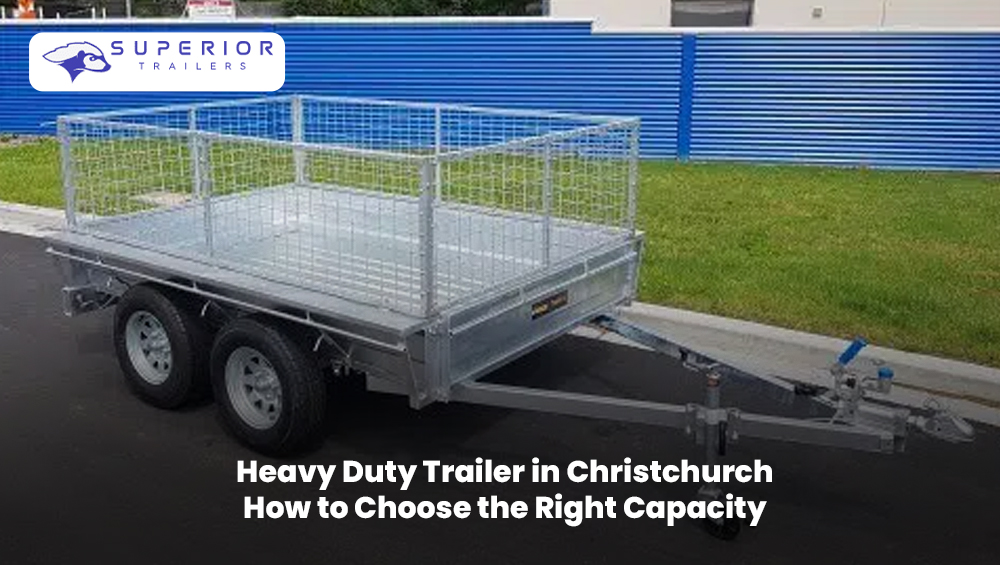
Heavy Duty Trailer in Christchurch: How to Choose the Right Capacity
Not sure which trailer capacity you need? Learn what to consider before choosing a heavy duty trailer for your next job.
A heavy-duty trailer is designed to carry demanding loads and handle regular transport requirements. It is commonly used by businesses and individuals who need to move equipment, building materials, landscaping supplies, machinery, and other heavy items.
Unlike smaller general-purpose trailers, heavy-duty models are selected according to their load capacity, construction, dimensions, and intended application.
For Christchurch businesses, a suitable trailer can support a wide range of everyday tasks, from transporting materials between job sites to moving equipment across commercial and rural properties.
What Makes a Trailer Heavy Duty?
Several factors influence whether a trailer is suitable for demanding work:
- Load capacity: The maximum permitted load weight and available payload.
- Chassis construction: A suitable frame that can handle the intended working loads.
- Axles and suspension: Components selected for the trailer’s rated capacity.
- Braking system: Appropriate brakes for the trailer’s weight and legal requirements.
- Deck construction: A surface suitable for the materials and equipment being transported.
The important point is to match these features to your actual requirements rather than choosing a trailer based on appearance alone.
Why Choosing the Right Trailer Capacity Matters
Trailer capacity directly affects how much material or equipment you can transport safely. Choosing an unsuitable model can create unnecessary trips, restrict your work, or encourage overloading.
For businesses that use trailers regularly, these problems can affect productivity and operating costs.
Avoiding Overloading
Overloading places additional pressure on the trailer’s tyres, axles, suspension, chassis, and braking components. It can also affect the handling of the towing vehicle.
Before purchasing, calculate the approximate weight of your usual loads. Remember to include accessories and equipment carried on the trailer.
Improving Everyday Efficiency
A trailer with suitable dimensions and payload capacity can reduce the number of trips required for certain jobs.
For example, a landscaping contractor transporting soil, mulch, and green waste may benefit from a trailer with sufficient deck space and a suitable tipping system.
Planning for Future Work
Your requirements may change as your business grows. Think about the materials, equipment, and loads you might need to transport over the next few years.
Choosing a suitable capacity from the beginning can help avoid replacing your trailer too soon.
How to Match Trailer Capacity to Your Type of Work
Different industries have different transport requirements. Understanding your daily work can help narrow down the right trailer size and configuration.
Construction and Building Projects
Construction businesses regularly transport tools, building materials, timber, and equipment between locations.
A heavy-duty trailer needs enough deck space for the items being carried, along with an appropriate payload rating. Contractors should also consider how easily materials can be loaded and secured.
For heavier equipment, check the trailer’s dimensions, loading arrangements, and rated capacity before making a decision.
Farming and Agricultural Operations
Farmers often need trailers for moving supplies, feed, equipment, and other materials around their properties.
A suitable trailer should match the weight and dimensions of the loads being transported. Ground conditions and access to loading areas may also influence the most practical configuration.
For regular agricultural work, consider how often the trailer will be used and whether additional capacity will be useful.
Landscaping and Gardening Businesses
Landscaping professionals frequently move soil, mulch, gravel, branches, green waste, and gardening equipment.
A heavy-duty tipping trailer can be particularly useful for loose materials that need to be unloaded at different job sites.
The correct deck size and tipping mechanism can make loading and unloading more convenient throughout a busy working day.
Commercial Transport and Equipment Hauling
Businesses transporting machinery, tools, and commercial supplies need to pay attention to both weight and dimensions.
A trailer may have enough payload capacity but insufficient deck space for longer equipment. Check the complete load requirements before selecting a model.
Also consider the towing vehicle’s rated capacity and the trailer’s coupling and braking specifications.
Understanding GLW, Payload, and Towing Capacity
One of the most important parts of buying a heavy-duty trailer is understanding its weight ratings.
These figures help determine how much the trailer can legally and safely carry.
What Is Gross Laden Weight (GLW)?
Gross Laden Weight refers to the maximum permitted weight of a trailer when fully loaded.
For example, Superior Trailers lists heavy-duty trailer options with GLW ratings of 1,750kg, 2,500kg, and 3,500kg, depending on the model.
These ratings should not be confused with the amount of cargo the trailer can carry.
What Is Trailer Payload?
Payload is the weight of the cargo you can carry after accounting for the trailer’s own unladen weight.
Simple calculation:
Payload = Gross Laden Weight − Trailer Tare Weight
For example, if a trailer has a GLW of 2,500kg and a tare weight of 800kg, its theoretical payload is 1,700kg.
Always confirm the actual tare weight and permitted payload of the specific model before purchasing.
Why Your Towing Vehicle Matters
Your towing vehicle must also be suitable for the loaded trailer.
Check the manufacturer’s towing limits, towbar rating, coupling compatibility, and applicable vehicle weight limits.
A trailer’s GLW does not automatically mean your vehicle can tow it at full capacity.
For additional guidance, refer to the NZ Transport Agency’s safe loading and towing information.
Key Features to Look for in a Heavy Duty Trailer
Trailer capacity is important, but construction and components also influence its suitability for regular use.
Strong Chassis and Drawbar Construction
The chassis supports the trailer and its load. The drawbar connects the trailer to the towing vehicle.
Check that both are designed and rated for the intended application. Their construction should match the trailer’s specified capacity.
Axles, Suspension, and Tyres
Axles, suspension, and tyres work together to support the trailer and maintain stability.
Their ratings should be appropriate for the trailer’s maximum laden weight. Ask about these specifications if you regularly transport heavy equipment or materials.
Braking Systems and Road Safety
Braking requirements depend on the trailer’s weight and applicable New Zealand regulations.
Check that the braking system is suitable for the trailer’s rated weight and that all components are maintained correctly.
A properly matched towing setup is important for safe braking and handling.
Galvanised Steel and Corrosion Protection
Trailers used outdoors can be exposed to rain, moisture, dirt, and changing weather conditions.
Galvanised steel provides a protective zinc coating that helps resist corrosion. This can be a useful consideration for businesses that store or operate trailers outside.
Also inspect the deck material, fittings, and other components to understand their maintenance requirements.
Standard Heavy Duty Trailers vs Heavy Duty Tipping Trailers
Not every job requires the same trailer configuration. A standard trailer and a tipping trailer serve different purposes.
When Should You Choose a Standard Heavy Duty Trailer?
A standard heavy-duty trailer can be suitable for transporting equipment, tools, machinery, and materials that need to remain securely positioned during travel.
It may be a practical choice for contractors, tradespeople, and businesses carrying a variety of items.
When Is a Tipping Trailer More Useful?
Tipping trailers are designed to make unloading loose materials easier.
They can be useful for transporting:
- Soil and landscaping materials
- Gravel and aggregate
- Green waste
- Building waste
- Other suitable bulk materials
Superior Trailers offers different tipping options, including winch, manual-hydraulic, and electric-hydraulic configurations on selected models.
The right option depends on your load, working conditions, and unloading frequency.
Common Mistakes to Avoid When Choosing a Trailer
Buying a trailer without checking its specifications can lead to problems later.
Here are some common mistakes worth avoiding.
Choosing Based Only on Price
A lower purchase price may seem attractive, but it should not be the only deciding factor.
Compare capacity, construction, available features, and suitability for your work before making a decision.
Ignoring the Trailer’s Tare Weight
A trailer with a higher GLW does not necessarily offer the same amount of payload as another trailer with an identical rating.
Always compare the actual tare weight and available payload.
Forgetting About Vehicle Towing Limits
Even if a trailer meets your load requirements, your towing vehicle must be rated for the combination.
Check the vehicle manufacturer’s specifications before purchasing.
Selecting the Wrong Trailer Size
A trailer that is too small may require additional trips. An unnecessarily large model may be less practical for your regular work.
Consider your usual load dimensions and available storage space.
Overlooking Loading and Unloading Requirements
Think about how materials will enter and leave the trailer.
If your work involves frequent transport of loose materials, a tipping configuration may be more practical than a standard deck.
Why Consider Superior Trailers in Christchurch?
Choosing a trailer is an investment in the way you work. You need a model that suits your loads, working environment, and transport requirements.
Superior Trailers provides heavy-duty trailer options for customers looking for practical transport solutions.
Its range includes standard heavy-duty trailers and heavy-duty tipping trailers, with different sizes and configurations available.
Heavy Duty Trailer Options
The available product range includes different GLW options and trailer dimensions.
Customers can explore configurations such as single-axle and tandem-axle tipping trailers, depending on the selected model.
Tipping Mechanism Options
Selected models offer winch, manual-hydraulic, and electric-hydraulic tipping options.
This gives customers different ways to approach unloading, depending on the type of work they undertake.
Modification Options
Available options listed on the website include EuroGrip hardwood decking, corrugated sheet metal decking, and different drawbar lengths.
These choices can help customers select a configuration suited to their working requirements.
Explore the Superior Trailers Heavy Duty Trailer range to compare available models and specifications.
Frequently Asked Questions
1 What Is the Best Heavy Duty Trailer for Commercial Use?
The best option depends on the materials, equipment, and weight you need to transport. Compare GLW, payload, deck dimensions, and construction before choosing a model.
2 What GLW Options Are Available at Superior Trailers?
Superior Trailers lists heavy-duty trailer options with GLW ratings of 1,750kg, 2,500kg, and 3,500kg. Availability depends on the model and configuration.
3 Should I Choose a Single-Axle or Tandem-Axle Trailer?
Your choice should depend on the trailer’s design, rated capacity, load requirements, and intended use. Compare the specifications of individual models rather than assuming one configuration is suitable for every job.
4 What Is the Difference Between a Standard and Tipping Trailer?
A standard trailer is designed to transport items on its deck. A tipping trailer includes a mechanism that raises the deck or body to help unload suitable loose materials.