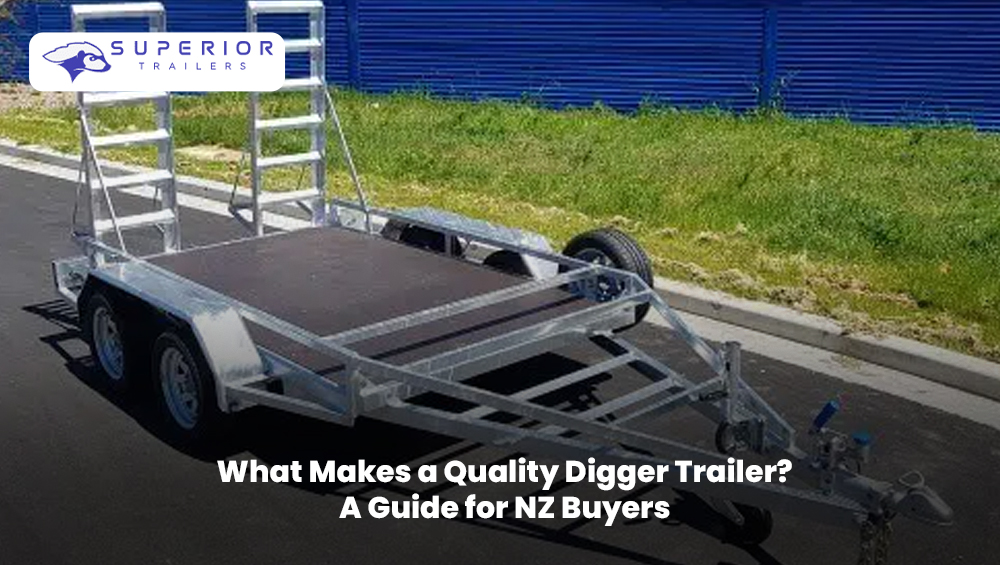
What Makes a Quality Digger Trailer? A Guide for NZ Buyers
Choosing a digger trailer? Learn how durability, load capacity and safety features help NZ buyers find the right trailer for the job.
Buying a digger trailer is an important decision for anyone working in construction, excavation, landscaping, or equipment hire. The right trailer makes moving machinery between jobs easier, while the wrong one can create unnecessary delays, maintenance costs, and safety concerns.
But how do you identify a trailer that offers the right balance of strength, practicality, and long-term value?
From load capacity and braking systems to loading access and construction quality, several factors deserve attention before you make a purchase. Understanding these features helps you compare available options and choose equipment that suits your daily workload.
If you are looking for digger trailers in New Zealand, this guide explains what to check before buying and how to find a suitable manufacturer for your requirements.
What Is a Digger Trailer and Who Needs One?
A digger trailer is designed to transport excavators and other compatible machinery between worksites. It is commonly used by excavation contractors, construction companies, landscapers, and equipment rental businesses.
For professionals who regularly move machinery, a suitable trailer can simplify transport planning and help reduce dependence on alternative transport arrangements.
Digger trailers can be useful for:
- Excavation contractors: Moving compact excavators between residential and commercial projects.
- Landscaping businesses: Transporting machinery to garden construction and site preparation jobs.
- Construction companies: Relocating equipment between building sites.
- Equipment hire businesses: Delivering machinery to customers and collecting it after use.
- Independent operators: Moving their own equipment between jobs without unnecessary logistical complications.
The best option depends on the machine being transported, the towing vehicle, travel distances, and how frequently the trailer will be used.
7 Key Features That Make a Quality Digger Trailer
Not all trailers are designed for the same workload. Before comparing prices, consider these seven features to understand what makes a trailer suitable for regular equipment transport.
1. Strong Construction and Durable Materials
A digger trailer must support substantial loads while handling the demands of regular transport. Its chassis, drawbar, axles, and deck all contribute to overall performance.
Look for a design that balances structural strength with trailer weight. A heavier trailer does not automatically mean better quality, particularly when payload capacity matters.
Ask the manufacturer about:
- Frame construction and steel specifications.
- Welding quality and structural reinforcement.
- Axle and suspension ratings.
- Deck construction and expected maintenance.
- Protection against corrosion and weather exposure.
Superior Trailers lists Australian and New Zealand steel and fully hot-dip galvanised construction among the features of its equipment transporters.
These details are worth checking when comparing digger trailers for commercial use.
2. The Right Load Capacity and Trailer Size
Choosing the correct capacity is essential. A trailer that cannot safely accommodate your excavator and accessories may limit your work or create serious transport risks.
Start by identifying your excavator’s operating weight and checking the manufacturer’s transport recommendations. Remember to account for attachments, buckets, accessories, and any additional equipment carried on the trailer.
You should also check the trailer’s gross laden weight (GLW), its tare weight, and the permitted payload.
A simple calculation:
Available payload = Maximum permitted loaded trailer weight − Trailer’s empty weight.
For example, if a trailer has a GLW of 3,500 kg and an empty weight of 900 kg, its theoretical payload is 2,600 kg. These figures are illustrative, not specifications for a particular Superior Trailers model.
The actual permissible load must also account for axle, tyre, coupling, towing vehicle, and other applicable limits.
Before buying, confirm that the trailer can accommodate your machine within all relevant ratings.
3. Reliable Braking Systems
Braking performance matters when transporting machinery on busy roads, steep sections, and changing road surfaces.
The appropriate braking system depends on the trailer’s design, weight rating, towing vehicle, and intended use.
When comparing options, ask about:
- The type of braking system fitted.
- The rated capacity of the braking components.
- Compatibility with your towing vehicle.
- Inspection and maintenance requirements.
- Any additional equipment required for your setup.
Superior Trailers offers digger trailers with mechanical-hydraulic brakes rated for loads up to 3,500 kg, according to its published equipment transporter information.
However, the maximum rating of a particular braking system should not be confused with the permissible loaded weight of every trailer.
Always confirm the specifications of the exact model you intend to purchase.
4. Easy Loading Ramps and Suitable Deck Height
Loading a compact excavator should be practical and controlled. The trailer’s deck height, ramp arrangement, available space, and approach angle can all affect the loading process.
A lower deck may improve loading access and towing characteristics, depending on the trailer design and machinery being carried.
Before making a decision, consider:
- Whether the machine can safely travel up the loading ramps.
- Whether the ramps suit the excavator’s tracks or wheels.
- The available deck length and width.
- Ground clearance and loading angles.
- The method used to secure the ramps during transport.
Superior Trailers highlights low deck height as a feature of its digger trailers, intended to improve towing characteristics and make loading safer.
Ask to review the relevant dimensions and loading arrangements before choosing a model.
5. Secure Tie-Down Points and Load Stability
Correctly securing machinery is essential for safe transport. Excavators can shift if the load is not positioned and restrained properly.
A quality trailer should provide suitable attachment points and a layout that supports secure load restraint.
Check the number, location, accessibility, and rated strength of the tie-down points. Also confirm that your planned restraint equipment is appropriate for the machine and complies with applicable requirements.
Other important considerations include:
- Positioning the excavator to achieve appropriate weight distribution.
- Preventing unwanted movement during travel.
- Securing buckets and removable attachments.
- Checking restraints before every trip.
- Following the machinery and trailer manufacturers’ loading instructions.
Superior Trailers lists multiple heavy-duty tie-down brackets among its digger trailer features.
These details can make a practical difference for contractors who move equipment regularly.
6. Corrosion Resistance and Weather Protection
Trailers used throughout New Zealand can face rain, moisture, road debris, and changing outdoor conditions. Corrosion protection is therefore an important consideration when assessing long-term ownership costs.
Look for a suitable protective finish and ask how the trailer should be maintained.
Hot-dip galvanising is one option used to protect steel against corrosion. Superior Trailers lists fully hot-dip galvanised construction in its equipment transporter range.
Even with protective coatings, regular maintenance remains important. Clean off accumulated dirt, inspect exposed areas, and address damage to protective finishes when necessary.
Pay particular attention to areas around joints, fittings, and components exposed to frequent wear.
7. Simple Maintenance and Long-Term Reliability
A trailer that is easy to inspect and maintain can help reduce avoidable downtime.
Before purchasing, ask about the recommended inspection schedule, replacement parts, servicing requirements, and access to support.
Check the condition and accessibility of important components, including:
- Tyres and wheel bearings.
- Brakes and associated components.
- Couplings and safety equipment.
- Lights and electrical connections.
- Suspension, axles, and structural joints.
- Loading ramps and restraint points.
Consider the trailer’s expected workload as well as its purchase price. A model that suits your daily operations and maintenance capabilities may offer better value over its working life.
How to Choose the Right Digger Trailer for Your Excavator
The right trailer should match your machinery rather than simply fit your budget.
Before comparing models, gather the following information:
Your excavator: Confirm its operating weight, transport dimensions, track width, and attachment requirements.
Your towing vehicle: Check the vehicle’s permitted towing capacity, towball download limits, and coupling compatibility.
Your regular workload: Consider whether you move machinery daily, travel long distances, or operate across multiple worksites.
Your loading requirements: Check the deck dimensions, loading angle, ramp arrangement, and available restraint points.
Your future needs: If you expect to upgrade your machinery, discuss suitable capacity options with the manufacturer.
Avoid selecting a trailer based only on its advertised maximum rating. The complete towing combination must remain within every applicable limit.
What Should NZ Buyers Check Before Purchasing?
Buying equipment involves more than comparing product photographs and prices. A few practical checks can help you make a more informed decision.
Use this checklist when comparing digger trailers:
- Confirm the excavator’s actual transport weight.
- Check the trailer’s GLW, tare weight, and payload.
- Verify towing vehicle and coupling compatibility.
- Review the braking system and relevant ratings.
- Inspect the loading arrangements and deck dimensions.
- Check tie-down points and load-restraint requirements.
- Ask about corrosion protection and maintenance.
- Confirm warranty conditions and available after-sales support.
- Request the exact model specifications before ordering.
It is also worth reviewing the applicable New Zealand transport rules. Check current requirements with Waka Kotahi NZ Transport Agency and confirm any model-specific questions with the manufacturer.
Why Choose a Reliable Digger Trailer Manufacturer?
A reputable manufacturer should be able to explain how its trailer suits your intended application.
Clear specifications, practical design, appropriate components, and useful product support are important when investing in equipment that may be used regularly.
When comparing a digger trailers manufacturer in New Zealand, consider:
Design suitability: Does the trailer match your machinery, transport needs, and expected workload?
Construction quality: Can the manufacturer explain the frame design, materials, component ratings, and corrosion protection?
Practical features: Are the loading arrangements, brakes, couplings, and tie-down points suitable for your application?
Product information: Are specifications and operating instructions available for the model you are considering?
Ongoing support: Can the business explain servicing, parts availability, and warranty coverage?
Choosing a manufacturer that answers these questions clearly helps you assess the product on its merits rather than relying on price alone.
Finding Quality Digger Trailers in Christchurch
For businesses searching for digger trailers in Christchurch, working with a local manufacturer can make it easier to discuss requirements and compare available designs.
Christchurch contractors may need to move machinery between residential projects, commercial construction sites, landscaping jobs, and regional worksites.
Before choosing a trailer, consider the types of roads you travel, the size of your excavator, your usual load, and the demands of your working schedule.
Superior Trailers is based in Christchurch and manufactures equipment transporters for demanding applications. Its published range includes digger, compactor, generator-set, air-compressor, and scissor-lift trailers.
The company explains that user input helped shape its digger trailer designs, with attention given to balancing strength and weight.
You can review its range and published specifications on the Superior Trailers equipment transporters page.
If you are comparing models, prepare your excavator specifications and towing vehicle details before contacting the team. This helps establish which options may suit your requirements.
Common Mistakes to Avoid When Buying a Digger Trailer
Even experienced operators can overlook important details when purchasing transport equipment.
Here are some common mistakes worth avoiding.
Choosing a trailer based on price alone: A lower initial cost does not necessarily mean better value. Compare construction, ratings, maintenance requirements, and suitability.
Ignoring the empty trailer weight: The trailer’s own weight affects how much equipment it can legally carry.
Overlooking towing limits: Your vehicle, coupling, trailer, and relevant components must all be suitable for the intended load.
Underestimating loading requirements: An unsuitable deck height or ramp arrangement can make loading more difficult.
Forgetting future requirements: Consider whether your machinery or workload could change over the next few years.
Skipping regular inspections: Even well-built trailers require routine checks and maintenance.
Taking time to assess these points can help you avoid purchasing a trailer that does not meet your operational needs.
Digger Trailer Maintenance Tips for Longer Service Life
Regular inspections help identify developing problems before they interrupt your work.
Follow the manufacturer’s maintenance instructions and pay attention to the following areas:
- Before each trip: Check tyres, lights, coupling security, restraints, and visible damage.
- Braking components: Arrange inspections and servicing at the recommended intervals.
- Wheels and suspension: Look for unusual wear, damage, or changes in performance.
- Protective finishes: Clean the trailer and inspect for coating damage or corrosion.
- Loading equipment: Check ramps, hinges, brackets, and attachment points for wear.
- After demanding use: Remove accumulated dirt and inspect areas exposed to impacts or abrasion.
Keep a record of maintenance and repairs. This can help you track recurring issues and maintain a consistent inspection routine.
Always follow the manufacturer’s instructions and seek professional assistance if you identify a safety concern.
Why Consider Superior Trailers for Your Equipment Transport Needs?
Superior Trailers offers equipment transporters developed with input from people who use this type of machinery in their work.
Its published digger trailer features include low deck height, heavy-duty tie-down brackets, mechanical-hydraulic braking options, multi-fit couplings, and storage for two buckets.
The company also highlights its focus on balancing strength and trailer weight.
These features are worth reviewing if you need a trailer for regular excavation, construction, or landscaping work. The right model will depend on your machine, towing vehicle, transport requirements, and budget.
Explore the digger trailer range from Superior Trailers to review available information.
If you are unsure which option suits your equipment, contact the team with your excavator weight, dimensions, and towing vehicle details. They can help you understand the available options and identify the specifications you need to check before purchasing.
Frequently Asked Questions
1. What makes a digger trailer high quality?
A quality digger trailer combines suitable load capacity, durable construction, appropriate braking, practical loading access, secure tie-down points, and corrosion protection. It should also match your machinery and towing vehicle.
2. How do I choose the right digger trailer capacity?
Start with the excavator’s transport weight, including attachments and accessories. Compare this with the trailer’s payload, GLW, and component ratings. Also verify the towing vehicle’s limits before selecting a model.
3. What safety features should a digger trailer have?
Important considerations include suitable brakes, secure coupling equipment, appropriate tyres, effective lighting, correctly rated tie-down points, and safe loading arrangements. The required setup depends on the trailer and its intended use.
4. How do I find a reliable digger trailer manufacturer in New Zealand?
Compare construction quality, technical specifications, product suitability, maintenance requirements, warranty terms, and customer support. Ask manufacturers to explain how their models meet your machinery and towing requirements.
5. Where can I find digger trailers in Christchurch?
Superior Trailers is based in Christchurch and offers a range of equipment transporters, including digger trailers. Visit its equipment transporters page to review the published product information.
Conclusion: Choose a Digger Trailer That Suits Your Work
A quality digger trailer should do more than carry machinery. It should suit your excavator, work with your towing vehicle, provide practical loading access, and meet the demands of regular transport.
By checking capacity, construction, brakes, tie-down points, and maintenance requirements, you can compare available options with greater confidence.
For contractors and businesses researching digger trailers in Christchurch, Superior Trailers provides a local option to consider. Review the specifications, discuss your requirements, and choose a trailer that supports your work safely and efficiently.