Scissor-Lift Trailers in Christchurch: What to Look for Before You Buy
Choosing scissor-lift trailers in Christchurch? Check lifting capacity, stability and safety features to find the right trailer for your needs.
Moving a scissor lift between worksites should not involve unnecessary hassle. The right trailer makes loading, securing and transporting equipment much more manageable. However, choosing one involves more than finding a trailer that looks strong enough.
You need to consider the machine’s weight, loading method, trailer capacity and towing requirements. These details matter for construction companies, equipment-hire businesses and contractors working across Christchurch and the wider Canterbury region.
If you are comparing scissor-lift trailers in Christchurch, understanding these features will help you make a more informed buying decision.
What Is a Scissor-Lift Trailer?
A scissor-lift trailer is designed to transport scissor lifts between construction sites, commercial properties, warehouses and other workplaces. Unlike a general-purpose trailer, it includes features intended to make loading and securing lifting equipment easier.
Scissor lifts can be heavy, and their dimensions vary between models. A suitable trailer must accommodate the machine while providing sufficient capacity for safe transport.
Common features to look for include:
- A strong chassis designed for heavy equipment.
- A low-profile or tilting chassis for easier loading.
- Wide loading ramps suited to the machine.
- A suitable winch for assisted loading.
- Heavy-duty tie-down points.
- A durable, non-slip deck.
- Appropriate braking and towing components.
These features are particularly useful for businesses that move equipment regularly or hire machinery to different customers.
Key Features to Check Before Buying a Scissor-Lift Trailer
Before choosing a trailer, compare its specifications with the scissor lift you intend to transport. Paying attention to the following details can help you avoid an unsuitable purchase.
Payload Capacity and Gross Laden Weight (GLW)
Capacity should be one of your first considerations.
Gross Laden Weight (GLW) refers to the maximum permitted total weight of a loaded trailer. It is not the same as the weight of the equipment the trailer can carry.
For example, a trailer rated at 2,500kg GLW does not automatically carry 2,500kg of equipment. The trailer’s own weight must also be accounted for.
Before buying, check:
- The operating weight of your scissor lift.
- The trailer’s tare weight and available payload.
- Any additional equipment or accessories being transported.
- The towing vehicle’s permitted towing capacity.
- Applicable axle, coupling and braking limits.
Superior Trailers offers scissor-lift trailer models with GLW ratings ranging from 1,750kg to 3,500kg. The appropriate model depends on the machine and the complete towing setup.
Trailer Dimensions and Scissor-Lift Compatibility
Weight is only one part of the decision. Your scissor lift must also fit the trailer correctly.
Measure the machine’s overall length, width and transport height. Consider its wheelbase, tyre position and ground clearance when assessing compatibility.
A trailer that is too narrow can make loading difficult. Insufficient deck space can also affect positioning and load security.
Before ordering, confirm the trailer dimensions with the manufacturer. If you operate several scissor-lift models, discuss whether one trailer can accommodate all of them safely.
Loading Ramps and Deck Height
Loading equipment becomes more challenging when the trailer deck sits too high or the ramps are unsuitable.
Look for ramps that accommodate the machine’s wheelbase, width and approach angle. They should provide suitable support and a secure path onto the deck.
A low-profile design can reduce the height difference between the ground and trailer deck. This can make loading more manageable, depending on the machine and loading conditions.
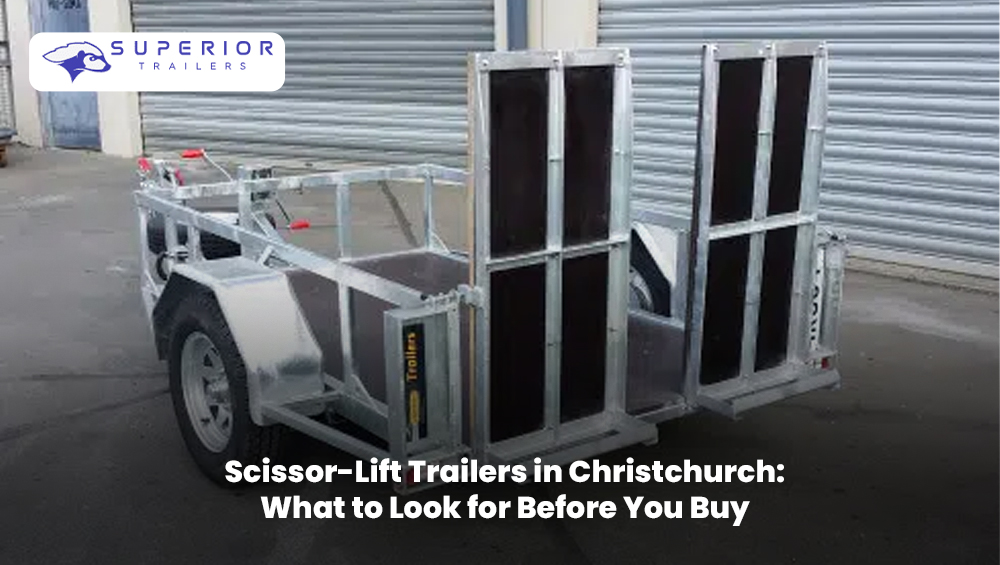
Superior Trailers designs its scissor-lift trailers with a low-profile, tilting chassis and wide loading ramps. These features are intended to simplify equipment loading.
Chassis Strength and Durability
Commercial trailers often experience frequent loading, unloading and road travel. Their construction needs to suit that workload.
When comparing options, examine the chassis design, structural components, weld quality and overall build.
A fully hot-dip galvanised finish is another useful feature to consider. It provides corrosion protection, which can help maintain the trailer when exposed to rain and outdoor working conditions.
Superior Trailers uses Australian and New Zealand steel in its scissor-lift trailer range and offers fully hot-dip galvanised construction.
Braking Systems and Towing Requirements
Braking requirements depend on the trailer’s rating, loaded weight, towing vehicle and applicable regulations.
Check that the braking system is appropriate for the intended use. Also confirm that the tow vehicle, coupling and electrical connections are compatible with the selected trailer.
Superior Trailers offers mechanical-hydraulic disc brakes on its 2,500kg and 3,500kg GLW scissor-lift trailer models. An electric drum-brake option is available for the 3,500kg model.
The 1,750kg GLW model is listed as unbraked, so buyers should confirm its suitability for their particular application.
Never assume that a particular trailer rating automatically makes it suitable for every towing vehicle.
Tie-Down Points and Load Security
A scissor lift must remain properly secured during transport. Movement on the road can create risks for the equipment, driver and other road users.
Look for accessible, heavy-duty tie-down points that suit the machine’s approved securing locations.
Before purchasing, consider where the restraints will sit and whether they can secure the machine without interfering with vulnerable components.
Superior Trailers includes multiple heavy-duty tie-down brackets in its scissor-lift trailer design. Always follow the equipment manufacturer’s instructions and use suitable restraints.
How Does a Low-Profile Trailer Make Loading Easier?
A low-profile trailer reduces the height between the ground and the deck. This can help reduce the ramp angle and make loading easier when combined with suitable ramps.
A tilting chassis can provide another practical advantage. Instead of relying entirely on a fixed deck and separate ramps, the trailer’s loading design helps create a more manageable route onto the platform.
These features can be valuable for equipment-hire companies and contractors who move scissor lifts throughout the working week.
However, low-profile construction alone does not guarantee compatibility. Check the machine’s ground clearance, wheel dimensions and manufacturer’s loading instructions before choosing a trailer.
Why Are Loading Winches and Non-Slip Decks Important?
Loading equipment requires careful control. A suitable winch can assist with moving a machine onto a trailer, particularly when the trailer’s design supports winch-assisted loading.
Before choosing a winch, confirm its rated capacity, mounting arrangement and compatibility with the equipment. Follow the manufacturer’s instructions, and never use a winch as a substitute for proper load securing.
The deck surface also deserves attention.
A durable, non-slip deck can provide a more suitable working surface during loading and unloading. It should be maintained in good condition and kept free from oil, mud and other materials that could reduce traction.
Superior Trailers’ scissor-lift trailers feature a manual loading winch and a non-slip EuroGrip hardwood deck.
Together with the tilting chassis and wide ramps, these features are designed to make equipment handling more practical.
Choosing a Scissor-Lift Trailer for Christchurch Worksites
Christchurch businesses may need to transport equipment between construction projects, industrial facilities, commercial premises and locations across Canterbury.
The right trailer depends on how frequently the machine travels, the distance involved and the conditions in which it operates.
For example, an equipment-hire company may prioritise durability and straightforward loading because different customers use its trailers. A contractor working with one scissor-lift model may focus more closely on exact dimensions and payload requirements.
When assessing your options, consider:
- Frequency of use: Daily transport places different demands on a trailer than occasional use.
- Travel routes: Consider the roads and access conditions you regularly encounter.
- Loading facilities: Check whether you will load on level, firm ground.
- Equipment variety: Determine whether you need to carry one machine or several models.
- Maintenance: Ask about servicing, inspections and replacement components.
Buying locally can also make it easier to discuss specifications and potential modifications with a trailer manufacturer.
Superior Trailers is based in Christchurch and serves customers throughout the South Island.
Standard vs Custom Scissor-Lift Trailers: Which Is Right for You?
A standard trailer can be a practical option when its specifications match your equipment and working requirements.
Customisation may be worth discussing if your scissor lift has unusual dimensions, specific loading needs or requirements that a standard model cannot accommodate.
| Consideration | Standard trailer | Custom solution |
| Equipment dimensions | Suitable for compatible machines | Can address specific dimensional requirements |
| Loading arrangements | Uses the available design | May allow tailored loading features |
| Purchase planning | Compare existing specifications | Requires discussion and confirmation of design |
| Best suited to | Common equipment configurations | More specialised transport requirements |
Customisation does not automatically make a trailer safer or better. Any changes must be properly designed and compatible with the intended load and towing setup.
Superior Trailers offers trailer modifications and works with customers to develop solutions for specific requirements. Discuss your machine’s specifications before deciding which option makes sense.
Common Mistakes to Avoid When Buying a Scissor-Lift Trailer
A few oversights can lead to additional costs or an unsuitable trailer. Keep these common mistakes in mind.
Choosing by GLW alone: Check the actual payload after accounting for the trailer’s tare weight.
Ignoring machine dimensions: Confirm the deck dimensions, ramp width, wheelbase and clearance.
Overlooking towing compatibility: Check the vehicle’s limits, coupling and braking requirements.
Treating ramps as an afterthought: Make sure the loading arrangement suits the equipment.
Forgetting load security: Check the tie-down points and approved restraint arrangements.
Buying without considering future needs: If you expect to use different scissor-lift models, discuss compatibility before committing.
Taking time to check these details can help you choose a trailer that fits your day-to-day operations.
Scissor-Lift Trailer Buying Checklist
Use this checklist when comparing models or speaking with a trailer manufacturer.
- Confirm the scissor lift’s operating weight.
- Check the trailer’s GLW, tare weight and available payload.
- Measure the machine and compare its dimensions with the deck.
- Confirm ramp width, loading angle and ground clearance.
- Ask whether a tilting chassis and loading winch suit your application.
- Check the deck surface and tie-down arrangements.
- Verify the braking system and coupling requirements.
- Confirm compatibility with your towing vehicle.
- Discuss warranty, maintenance and possible modifications.
- Request a written specification before placing your order.
Completing these checks makes it easier to compare trailers based on suitability rather than price alone.
Why Consider Superior Trailers in Christchurch?
Superior Trailers develops equipment transporters for practical working environments, with a focus on durability, usability and equipment safety.
Its scissor-lift trailer range includes models from 1,750kg to 3,500kg GLW. Features include a tilting chassis, manual loading winch, non-slip hardwood deck, wide loading ramps and heavy-duty tie-down brackets.
The range also includes galvanised construction and different braking options, depending on the model.
If you are unsure which configuration suits your equipment, discuss the machine’s weight, dimensions and towing vehicle with the team before choosing.
Explore the Superior Trailers equipment transporter range to review the available features and options.
Need help choosing a trailer for your scissor lift? Contact Superior Trailers to discuss your requirements and find a suitable option for your work.
Frequently Asked Questions
1 What size trailer do I need for my scissor lift?
The right size depends on the machine’s operating weight, dimensions, wheelbase and loading requirements. Check the trailer’s available payload and deck dimensions before making a decision.
2 What GLW should I look for in a scissor-lift trailer?
Choose a GLW rating that accommodates the loaded trailer within all applicable weight limits. Remember that GLW includes the trailer itself, so it is not equal to the available payload.
3 Can I tow a scissor-lift trailer with a standard vehicle?
Possibly, provided the vehicle is approved to tow the loaded trailer and meets all applicable requirements. Check the vehicle’s towing limits, coupling compatibility, braking requirements and other relevant restrictions.
4 Are low-profile trailers better for loading scissor lifts?
A low-profile trailer can reduce the height difference between the ground and deck. When combined with suitable ramps or a tilting chassis, it can make loading more manageable. Suitability depends on the machine and trailer design.
5 Can I customize a scissor-lift trailer to suit my equipment?
Modifications may be possible, depending on the requirements and design. Discuss your machine’s dimensions, weight and loading needs with the manufacturer before ordering.
Final Thoughts: Choosing the Right Scissor-Lift Trailer
Choosing a scissor-lift trailer is about finding the right combination of capacity, loading convenience, durability and towing compatibility.
Check the machine’s weight and dimensions first. Then compare the chassis, ramps, winch, deck, tie-down points and braking system. These details help you assess whether a trailer will suit your equipment and working conditions.
For businesses looking for scissor-lift trailers in Christchurch, Superior Trailers offers a range of equipment transporters designed around practical loading and transport needs.
Review the specifications, ask questions and confirm compatibility before buying. A well-matched trailer can help make equipment transport more straightforward for your business.