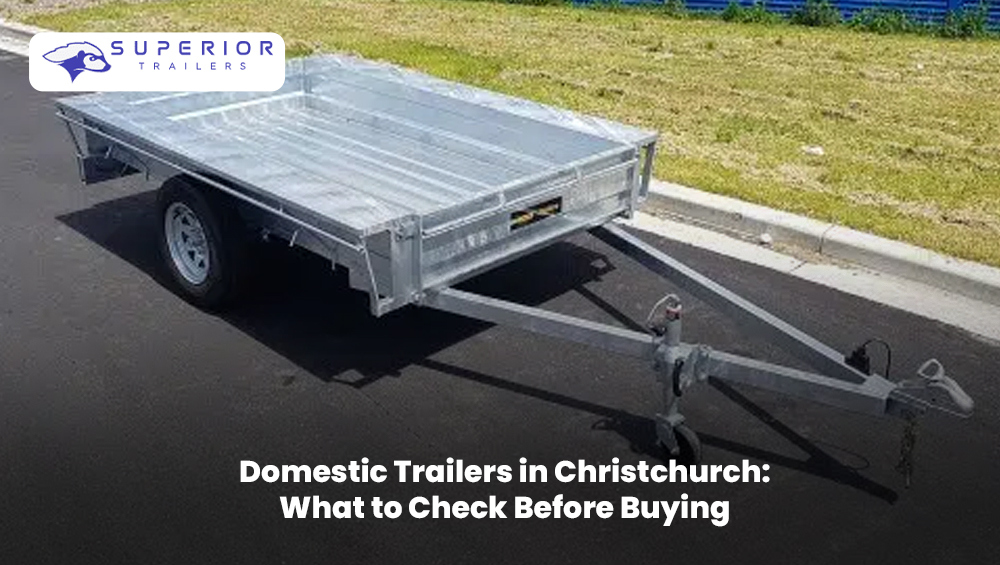
Domestic Trailers in Christchurch: What to Check Before Buying
Looking for domestic trailers in Christchurch? Check the size, build quality, towing setup and safety features before making your next trailer purchase.
Choosing a trailer is one of those decisions that looks simple until you start comparing sizes, axle options, load ratings, construction, features and towing requirements.
For Christchurch homeowners, tradespeople, landscapers and small businesses, a domestic trailer can be useful for everything from transporting garden waste and tools to moving furniture, building materials and weekend equipment. But the right trailer should do more than simply carry a load. It needs to suit your vehicle, your regular jobs and the way you intend to use it.
If you are comparing Domestic Trailers in Christchurch, here are the key things worth checking before you buy.
What Is a Domestic Trailer?
A domestic trailer is generally designed for everyday personal and light commercial hauling rather than specialised heavy-duty applications.
Typical uses include:
- Transporting garden and green waste
- Moving household furniture
- Carrying tools and equipment
- Taking building supplies to a project
- Transporting bikes and recreational gear
- General property maintenance
- Supporting small landscaping or trade jobs
The important thing is that “domestic” does not automatically mean basic. A well-designed trailer can combine useful load capacity with practical dimensions, durable materials and features that make regular towing easier.
Superior Trailers offers standard domestic models as well as domestic tipping options, giving buyers different configurations depending on their intended use.
Why Trailer Size Matters
Bigger is not always better.
Before buying, think about the loads you regularly transport rather than the largest load you might carry once a year.
For example, someone mainly moving garden waste may need a different setup from a homeowner transporting furniture or a contractor carrying equipment.
Consider:
- Trailer length and width
- Internal deck space
- Side height
- Available load capacity
- Towing vehicle compatibility
- Where the trailer will be stored
- How easy it will be to manoeuvre
A trailer that is too small can become frustrating quickly. One that is unnecessarily large may be harder to tow, park and store.
The goal is to find the practical middle ground.
Check the Trailer’s Weight Rating
Weight is one of the most important things to understand before purchasing a trailer.
New Zealand classifies light trailers as vehicles with a maximum gross vehicle mass of 3,500kg or less. The GVM includes the trailer and its maximum permitted load.
Superior Trailers’ domestic range includes models from 1,500kg to 2,500kg GLW, depending on configuration. This gives buyers different options depending on the job they need the trailer to perform.
However, don’t choose a trailer based only on its maximum rating.
Your towing vehicle also has its own limits.
Before buying, check:
- The trailer’s permitted weight.
- The towing capacity of your vehicle.
- The weight of the trailer itself.
- The weight of the load you intend to carry.
- The towbar and coupling requirements.
This simple step can prevent an expensive mistake.
Single Axle vs Tandem Axle
Another common question is whether you should choose a single axle or tandem axle trailer.
Single axle
A single axle configuration can be a practical choice for lighter everyday work. It can also be easier to manoeuvre and may suit homeowners who don’t regularly transport heavier loads.
Tandem axle
Tandem axle trailers can provide additional stability and are often considered when carrying larger or heavier loads.
The better option depends on your vehicle, typical load and intended use.
Rather than choosing based purely on appearance, think about what you will realistically transport throughout the year.
Look at Construction Quality
A trailer can look excellent when it is sitting in a showroom. The real test is how it performs after repeated use.
Pay attention to:
- Frame construction
- Weld quality
- Drawbar design
- Suspension
- Coupling
- Flooring
- Tie-down points
- Lights and wiring
- Corrosion protection
- Wheel and tyre setup
Superior Trailers’ domestic models use hot-dipped galvanised construction and Australian and New Zealand steel, along with features such as LED tail lights and internally installed wiring.
Galvanising is particularly worth considering in a trailer that will spend plenty of time outdoors because corrosion protection can make a difference to long-term durability.
Think About How You Will Use the Trailer
This is where many buyers go wrong.
Instead of asking, “Which trailer looks best?”, ask:
“What will I actually use it for?”
A homeowner might need it for garden waste, DIY materials and furniture.
A landscaper could regularly carry equipment, green waste and supplies.
A tradesperson might need space for tools and building materials.
A small business may require a trailer that can handle frequent loading and unloading.
Your answers should influence the trailer’s size, axle configuration, load rating and optional features.
The best trailer is not necessarily the most expensive one. It is the one that matches your real workload.
Standard vs Tipping Trailers
For general hauling, a standard domestic trailer may be all you need.
But if you regularly transport loose materials, a tipping trailer can make unloading considerably easier.
Domestic tipping trailers are available with different tipping mechanisms, including winch, manual-hydraulic and electric-hydraulic options. Each setup has different advantages depending on how and where the trailer is used.
For example, someone who values simplicity may prefer a straightforward mechanism, while frequent users may prioritise easier hydraulic operation.
Think about your normal unloading conditions before paying for features you may rarely use.
Towing and Loading Safety in New Zealand
Buying the right trailer is only part of the equation. Loading and towing it correctly matters just as much.
NZTA states that a light trailer must be licensed and have a current WoF, and its coupling, safety equipment, tyres and other required components need to be in safe working condition.
Load distribution is particularly important.
NZTA advises that a simple trailer should have approximately 10% of the trailer and load weight acting downward on the tow coupling to help maintain stability. The load should also be distributed centrally over the trailer axle or axles.
You should also remember that towing changes the way your vehicle handles.
The maximum open-road speed for a light vehicle towing a trailer is 90km/h, and NZTA recommends allowing additional following distance because the extra weight affects braking and stability.
Before every trip, check:
- Coupling connection
- Safety chain or cable
- Tyres
- Lights
- Load security
- Weight distribution
- Trailer doors or tailgates
- Number plate and licence requirements
A few minutes of checking can make a significant difference.
Features That Make Everyday Jobs Easier
Small design decisions can have a surprisingly large impact on everyday trailer use.
Depending on your needs, useful features can include:
- Removable cages
- H-frames
- Tie-down rails
- Front and rear tailgates
- Non-slip decking
- Heavy-duty light protection
- Galvanised components
- Quality jockey wheels
Superior Trailers’ domestic range includes options such as removable cages and H-frames, all-around tie-down rails, non-slip EuroGrip hardwood decking and different wheel and suspension configurations.
These aren’t just cosmetic additions. They can make loading, securing and unloading different types of cargo much more convenient.
Why Choose Superior Trailers?
When comparing Domestic Trailers in Christchurch, it makes sense to look beyond the basic price tag.
Superior Trailers is a Christchurch-based trailer manufacturer offering standard and bespoke light trailers in New Zealand. The company also provides trailer servicing and repairs, giving customers support beyond the initial purchase.
Its domestic range has been designed around versatility, durability and practical everyday use, with both standard and tipping configurations available.
That matters because a trailer is not usually a short-term purchase. You want something that can continue to perform as your needs change.
Frequently Asked Questions
1 What are domestic trailers commonly used for?
Domestic trailers are commonly used for household moves, garden waste, DIY materials, tools, equipment, landscaping supplies and other everyday hauling jobs.
2 What size domestic trailer should I buy?
Choose a size based on your typical load rather than the biggest load you might carry occasionally. Always consider your vehicle’s towing capacity and the trailer’s permitted weight.
3 Are domestic trailers suitable for business use?
Yes. Depending on their specifications, domestic trailers can be useful for tradespeople, landscapers, contractors and small businesses carrying lighter equipment and materials.
4 What is the difference between a standard and tipping trailer?
A standard trailer is designed primarily for carrying and transporting loads. A tipping trailer adds a mechanism that helps raise the trailer body, making it easier to unload certain loose materials.
5 Are tandem axle trailers better than single axle trailers?
Not necessarily. Tandem axle models may suit heavier or larger loads, while single axle trailers can be practical for lighter everyday applications. The right choice depends on your vehicle and workload.
Final Thoughts
A domestic trailer should make your work easier, not create another problem to manage.
Start with your typical loads, check your vehicle’s towing limits, consider the trailer’s construction and choose features that genuinely fit your lifestyle or business. Don’t overlook safety, load distribution or ongoing maintenance either.
For Christchurch buyers, choosing a trailer from a manufacturer that understands everyday New Zealand towing requirements can also provide valuable peace of mind.
If you’re comparing Domestic Trailers, take the time to look at the specifications rather than choosing purely on price. The right combination of capacity, construction, usability and support can turn a trailer into one of the most useful pieces of equipment you own.