What Makes a Scissor-Lift Trailer Suitable for Daily Commercial Use in Christchurch?
Need reliable lifting on the job? Find out how scissor-lift trailers support safer handling, easy transport and daily commercial work in Christchurch.
Moving a scissor lift between worksites sounds straightforward until loading takes longer than expected, the trailer does not fit the machine properly, or the towing setup creates unnecessary complications.
For construction companies, equipment hire businesses and contractors, these challenges can affect the working day. Equipment needs to reach each site safely, without creating avoidable delays.
Choosing the right Scissor-Lift Trailers in Christchurch involves more than checking the maximum weight rating. Loading design, deck construction, braking systems and equipment compatibility all play an important role.
If your business regularly transports lifting equipment around Christchurch and Canterbury, understanding these features can help you make a better purchasing decision.
What Makes Transporting Scissor Lifts Different from Other Equipment?
Scissor lifts are designed to provide elevated access for construction, maintenance, installation and other commercial tasks. However, transporting them requires a trailer that suits their specific dimensions and weight.
Unlike smaller tools or general materials, lifting equipment needs adequate deck space, suitable loading arrangements and secure restraint points.
For example, an equipment hire company might move several machines between customer locations throughout the week. A contractor might need to transport a scissor lift between multiple construction projects.
In both situations, the trailer must accommodate the equipment without making loading and unloading unnecessarily difficult.
Some important considerations include:
- Machine weight: The trailer must have sufficient available payload for the scissor lift and any permitted additional equipment.
- Overall dimensions: Deck length, width and loading arrangements must suit the machine.
- Loading access: Ramps, deck height and chassis design affect how equipment gets onto the trailer.
- Load security: Suitable tie-down points and restraints help keep equipment secure during transport.
- Towing compatibility: The trailer, loaded weight and towing vehicle must work within their respective limits.
These requirements explain why a purpose-designed scissor-lift trailer can be a practical choice for businesses that regularly transport lifting equipment.
5 Essential Features of a Reliable Scissor-Lift Trailer
Not every equipment trailer offers the same loading experience or construction. Before choosing a model, look closely at the features that support regular commercial use.
1. Low-Profile Chassis for Easier Loading
Deck height affects the loading angle between the ground and the trailer.
A lower deck can reduce the height difference, helping create a more manageable loading arrangement when paired with suitable ramps or a tilting chassis.
This is particularly useful when equipment needs to be moved regularly between different locations.
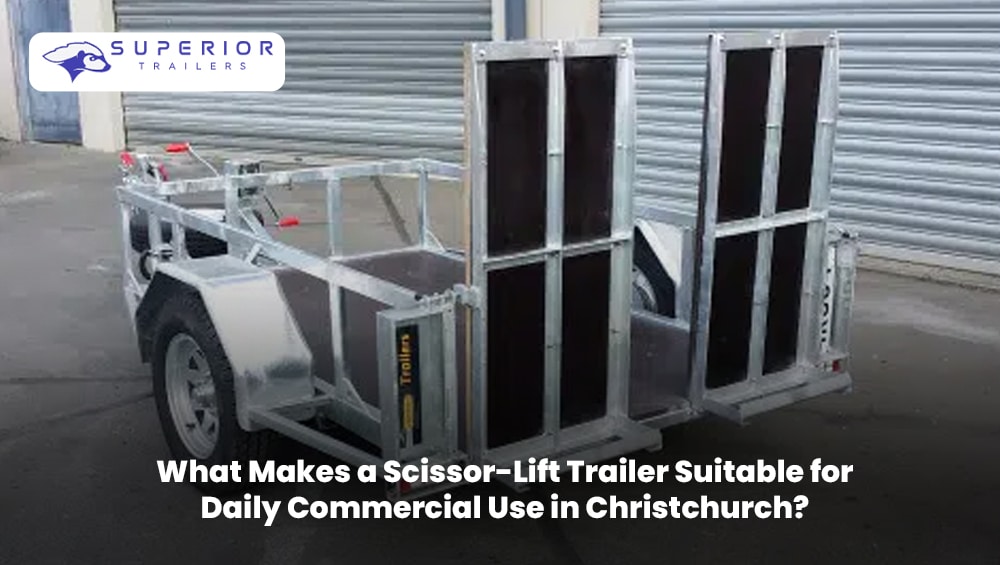
Superior Trailers designs its scissor-lift trailers with a low-profile chassis to support practical equipment loading.
2. Tilting Chassis for Improved Loading Access
A tilting chassis can make a noticeable difference when loading heavy machinery.
Rather than relying entirely on a fixed deck arrangement, the trailer can tilt to create a loading position suited to the equipment.
This design can help simplify the process for operators, provided the loading method is compatible with the machine and manufacturer’s instructions.
For businesses handling frequent equipment movements, it is worth considering how the tilting mechanism fits into everyday operations.
3. Wide Loading Ramps
Ramp width is another important detail.
Scissor lifts come in different sizes, so a ramp arrangement that works for one machine might not suit another.
Before purchasing, check:
- The width of the scissor lift.
- Its wheelbase and tyre positioning.
- The available ramp width.
- Ground clearance and approach angle.
- The manufacturer’s recommended loading procedure.
Superior Trailers includes wide loading ramps in its scissor-lift trailer range to accommodate different scissor-lift sizes.
4. Strong Tie-Down Points
Once the machine is loaded, securing it correctly is essential.
A suitable trailer should have accessible, heavy-duty tie-down points that work with the equipment’s approved restraint locations.
Poorly positioned restraints can make securing machinery more difficult. They may also create problems if straps interfere with vulnerable parts of the machine.
Superior Trailers incorporates multiple heavy-duty tie-down brackets into its scissor-lift trailer designs.
Always follow the equipment manufacturer’s load-securing instructions and use appropriately rated restraints.
5. Durable Deck and Galvanised Construction
Commercial trailers regularly face outdoor conditions, road travel and repeated loading.
A durable deck provides a suitable surface for equipment handling, while galvanised construction offers corrosion protection.
Superior Trailers uses a non-slip EuroGrip hardwood deck and fully hot-dip galvanised construction.
The trailers are also manufactured using Australian and New Zealand steel.
These construction details are worth considering when comparing equipment transporters for regular business use.
How to Choose the Right Trailer Weight Capacity
Trailer capacity should be one of the first things you check before purchasing.
However, there is an important difference between Gross Laden Weight (GLW) and available payload.
GLW refers to the maximum permitted total weight of the loaded trailer. This includes the trailer itself and its load.
For example, a trailer rated at 2,500kg GLW does not automatically have 2,500kg of available payload.
You need to subtract the trailer’s tare weight to determine its available carrying capacity.
Superior Trailers offers three scissor-lift trailer configurations:Why Loading Efficiency Matters on Busy Worksites
Time matters when equipment moves between construction projects and commercial properties.
A difficult loading process can create delays, especially when machinery needs to be transported several times throughout the working week.
Consider an equipment hire business delivering a scissor lift to different customers. The trailer needs to support a loading arrangement that operators can understand and use correctly.
A suitable combination of features can help make this process more manageable.
For example:
- A tilting chassis provides an alternative loading arrangement.
- A manual winch assists with controlled equipment loading.
- Wide ramps provide suitable access for compatible machines.
- A non-slip deck offers a more suitable loading surface.
- Accessible tie-down brackets support proper load securing.
Superior Trailers includes these features in its scissor-lift trailer range.
The aim is to make equipment transport more practical for businesses that depend on lifting machinery.
Standard vs Custom Scissor-Lift Trailers: Which One Is Right for You?
The right choice depends on your equipment and working requirements.
A standard trailer may be suitable when its dimensions, payload and loading features match your scissor lift.
However, some businesses operate different equipment models or have specific transport requirements.
In these situations, discussing possible modifications with the manufacturer can help identify a suitable solution.
| Consideration | Standard trailer | Custom trailer |
| Equipment compatibility | Suits specified equipment sizes | Can address particular requirements |
| Loading arrangements | Existing design features | Potentially tailored design |
| Specifications | Based on available models | Discussed with the manufacturer |
| Best suited for | Common equipment requirements | More specialised applications |
Superior Trailers works with customers to develop trailer designs around their requirements.
If your business has specific loading or equipment dimensions, discuss these details before deciding on a standard or customised option.
What Christchurch Businesses Should Consider Before Buying
Christchurch has businesses operating across construction, property maintenance, industrial services and equipment hire.
These industries often require machinery to move between different worksites.
When choosing Scissor-Lift Trailers in Christchurch, think about how your business will use the trailer throughout the year.
Here are some practical points to consider.
Frequency of transport
Will the trailer be used occasionally or several times each day? Regular commercial use makes durability, loading convenience and maintenance important considerations.
Different equipment models
If you operate several scissor lifts, check whether their dimensions and weights are compatible with the same trailer.
Local working conditions
Think about the surfaces and access conditions where loading and unloading will take place. The loading setup should suit the locations where your business operates.
Towing requirements
Confirm your vehicle’s towing capacity, coupling compatibility and braking requirements before purchasing.
Future business requirements
If you expect to expand your equipment fleet, discuss your future needs with the manufacturer. This can help you avoid selecting a trailer that becomes unsuitable as your operations change.
Taking time to assess these points can make your purchasing decision more straightforward.
How the Right Trailer Can Improve Daily Business Operations
A trailer is more than a way to move equipment from one location to another. It becomes part of the daily workflow.
For a contractor, a suitable trailer helps make machinery transport more organised. For an equipment hire company, the right loading arrangement can support regular deliveries and collections.
The benefits depend on choosing a trailer that matches the equipment and intended use.
A well-matched trailer can help businesses:
- Make loading and unloading more manageable.
- Transport compatible machinery between worksites.
- Keep equipment properly secured during travel.
- Reduce unnecessary handling difficulties.
- Support regular equipment movements.
The important thing is to choose based on actual working requirements rather than appearance alone.
Why Choose Superior Trailers for Scissor-Lift Trailers in Christchurch?
When investing in an equipment transporter, the manufacturer matters just as much as the trailer specifications.
Superior Trailers is based in Christchurch and supplies trailer solutions to customers throughout the South Island.
Its scissor-lift trailer range has been developed with attention to strength, user safety and ease of use.
Available models range from 1,750kg to 3,500kg GLW, with features including:
- Low-profile, tilting chassis.
- Manual loading winch.
- Wide loading ramps.
- Non-slip EuroGrip hardwood deck.
- Multiple heavy-duty tie-down brackets.
- Fully hot-dip galvanised construction.
- LED tail lights with internally installed wiring.
- Low-profile, multi-fit couplings.
Different models also offer different running gear and braking configurations. The 1,750kg model is unbraked, while the 2,500kg and 3,500kg models have mechanical-hydraulic disc brakes. An electric drum-brake option is available for the 3,500kg model.
Superior Trailers also offers modification options for customers with specific requirements.
You can explore the available equipment transporters here:
https://superiortrailers.co.nz/products/equipment-transporters/
If you need help selecting a model, contact the team to discuss your scissor lift’s weight, dimensions and intended use.
Scissor-Lift Trailer Buying Checklist: 7 Things to Check Before Purchasing
Before making a final decision, use this checklist to compare your options.
- Weight capacity: Does the trailer have enough available payload for your scissor lift?
- Deck dimensions: Will your machine fit comfortably within the available space?
- Loading design: Are the ramps, deck height and tilting mechanism suitable?
- Winch arrangement: Is the loading winch appropriate for your equipment?
- Load security: Are the tie-down points suitable for the machine’s approved restraints?
- Towing compatibility: Does your vehicle meet the required towing and braking limits?
- Build quality: Is the trailer constructed for your expected working conditions?
Getting these details right before purchasing can help you avoid choosing a trailer that does not meet your business requirements.
Frequently Asked Questions
1. What is a scissor-lift trailer used for?
A scissor-lift trailer is designed to transport scissor lifts between construction sites, commercial properties, warehouses and other workplaces. Its loading and securing features are intended to accommodate this type of lifting equipment.
2. What weight capacities are available for Superior Trailers’ scissor-lift trailers?
Superior Trailers offers models with GLW ratings of 1,750kg, 2,500kg and 3,500kg. The correct option depends on the machine’s weight, trailer tare weight and towing requirements.
3. Are scissor-lift trailers available in Christchurch?
Yes. Superior Trailers is based in Christchurch and offers a range of scissor-lift trailers for equipment transport. Its team can discuss available models and specifications.
4. Why is a tilting chassis useful on a scissor-lift trailer?
A tilting chassis provides a loading arrangement that can make it easier to move compatible equipment onto the trailer. Its suitability depends on the machine’s dimensions, ground clearance and manufacturer’s loading instructions.